Renting · · 22 min read
Renting to students and renting as a student in Madrid and Barcelona in 2026: which contract to sign for an academic year, deposit, guarantor, padrón registration, halls of residence and how to avoid scams
Is a flat for the academic year a habitual home or temporary housing? For landlords and for students, we explain which contract applies under the LAU (Spain’s Urban Leases Act) and the October 2026 decrees, what happens if a seasonal let is misused, what Catalonia’s Law 11/2025 adds, how much deposit and guarantee can be requested, how a guarantor should sign, how to register on the padrón, which papers are usually requested if you come from abroad or on an Erasmus grant, when to start looking, what halls of residence offer and how not to fall for a scam.
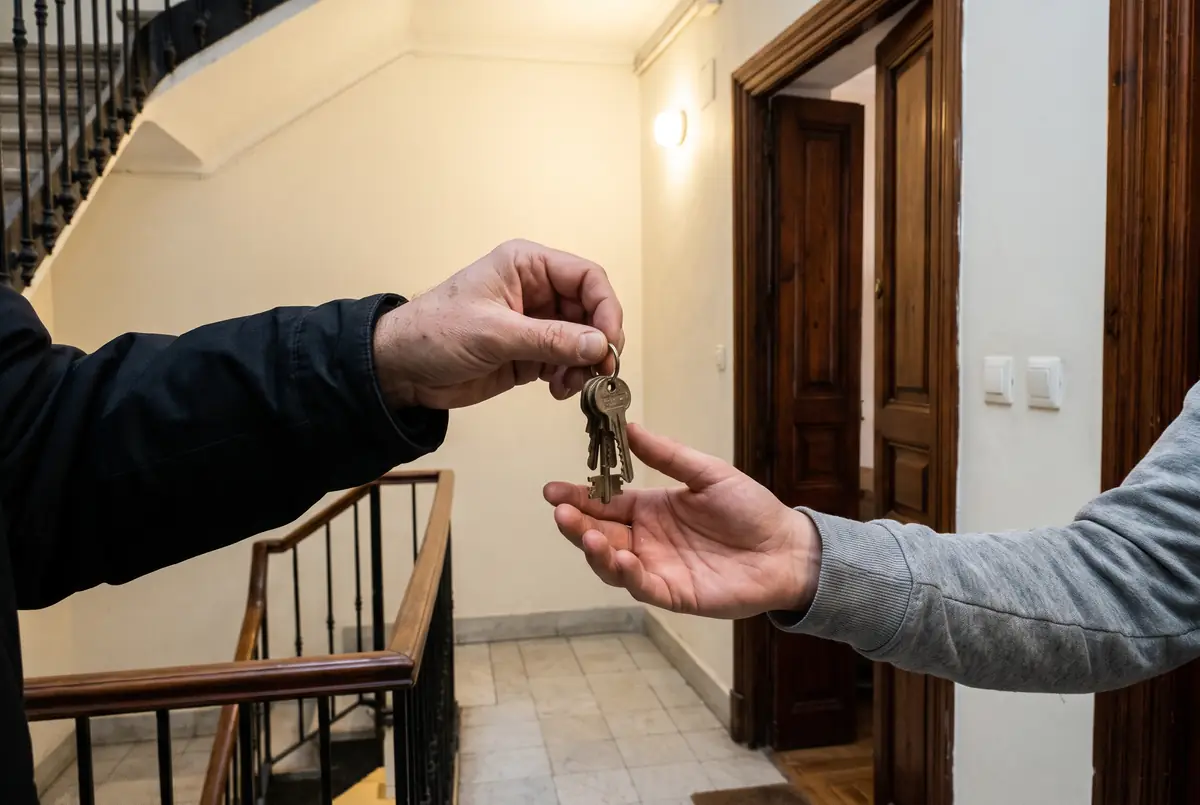
Every academic year, thousands of students look for a room or a flat in Madrid and Barcelona, and many landlords wonder which contract to give them. For years the usual answer was a ten-month “seasonal” contract (contrato de temporada), with two months’ deposit and no extension. Since 8 October 2026 it no longer works the same way: Spain’s Urban Leases Act (LAU) defines what a temporary let is, requires the reason to be real and written down, and if it is missing, turns the contract into a habitual-home lease. In Catalonia, its own law has also applied since 1 January 2026.
Based on what had been published as of 7 November 2026, we explain both sides: what you need to know if you rent to students and if you rent as a student. We cover rooms in “Renting a Room in Spain in 2026: Which Contract You Sign, Your Rights and What the Housing Decrees Change”; the city of Barcelona in “Renting a flat in Barcelona in 2026: the rent cap in stressed areas, the reference index, seasonal lets, rooms, fines and documents”; and what a contract cannot impose in “Rental contract clauses that are not valid in Spain in 2026: waivers, deposits, agency fees, rent increases, visits and the padrón, and how to check it before signing”. Here we focus on the academic year.
The key points in one minute
- Studying does not, on its own, make a let temporary. It is temporary housing if the student has moved away from their habitual home for a real reason stated in the contract; if the flat is their home and they have no other, it is a habitual-home lease, even if the contract says “one academic year”.
- Temporary housing lasts more than 31 days and, as a general rule, no more than 12 months. Without a reason, or with more than two consecutive temporary contracts with the same tenant, it becomes a habitual-home lease, with a five-year minimum term (seven if the landlord is a company).
- Deposit of one month’s rent for housing; additional guarantee of up to two months in a habitual-home lease and one in a temporary one. Rent default insurance and more than one month in advance cannot be required, and agency fees are paid by the landlord.
- In Catalonia, a temporary let for studies follows the housing rules on deposit, guarantees, rent and expenses, and if the purpose is not stated it is presumed to be a permanent home.
- A parent’s guarantee must be express and state how much and for how long they are liable.
- Do not pay anything before you have seen the property and the contract.
Habitual home or temporary housing? The question that decides everything
The LAU now distinguishes between a habitual-home lease, which covers the tenant’s need for housing, including a single room (article 2.1); a temporary-housing lease, introduced by Royal Decree-law 29/2026; and a lease for use other than housing, for premises or offices. This is how temporary housing is defined:
A temporary-housing lease shall mean a lease of a habitable building, including the partial lease of a room or space, that covers the tenant’s need for housing when they are temporarily away from their habitual home for a justified reason that can be proven.
Urban Leases Act (LAU), article 2.3, as worded by Royal Decree-law 29/2026 (our translation)
What matters is not being a student but having another habitual home that you have moved away from. The OCU (Spain’s main consumer organisation) sums it up in its analysis of 8 October 2026: being a student does not automatically make the let temporary. Its example is someone who keeps the family home in another city and moves for a nine-month master’s degree, which can fit. If the student settles in the city without keeping another habitual home, what the law requires is missing and a habitual-home lease applies. That does not tie them down: they can leave after six months with 30 days’ notice (article 11.1).
| Situation | Contract | Length | Deposit and guarantees | If the tenant leaves early |
|---|---|---|---|---|
| Student whose habitual home is in another city or country, coming for a year, a master’s or a semester | Temporary housing (LAU, arts. 2.3, 7.2 and 9 bis), with the reason in writing | More than 31 days and, as a general rule, no more than 12 months; can be extended by agreement if the reason continues | Housing deposit and an additional guarantee of no more than 1 month | After 1 month, with 10 days’ notice (art. 11.2) |
| Student who settles in the city with no other habitual home | Habitual home (art. 2.1) | As agreed, but the tenant can stay for up to 5 years (7 if the landlord is a company) | Deposit of 1 month and additional guarantee of up to 2 | After 6 months, with 30 days’ notice (art. 11.1) |
| Room in a shared flat | Habitual or temporary, depending on its purpose | That of its type | That of its type; the total for all rooms cannot exceed the rent for the whole flat (art. 17.9) | That of its type |
| “Seasonal” contract signed before 8-10-2026 | Remains a lease for use other than housing (eighth transitional provision) | Until the agreed date, with no extension; if renewed, it becomes temporary housing | Statutory deposit of 2 months (art. 36.1) | As agreed |
Source: LAU, consolidated text in the BOE (7 October 2026), and OCU (8 October 2026). Summary for guidance as of 7 November 2026; what comes from Royal Decree-law 29/2026 depends on the vote of 12 November. Rent default insurance can never be required from the tenant.
What happens if a seasonal contract is misused
A temporary contract must expressly state why the tenant has moved, and the law puts the burden of proof on the landlord:
That reason must be real and capable of being proven, with the burden of proving it falling on the landlord.
Urban Leases Act (LAU), article 7.2, as worded by Royal Decree-law 29/2026 (our translation)
If the reason is missing, the contract loses its temporary nature and is governed by the habitual-home rules “with retroactive effect from the signing of the contract”. The same happens, under article 9 bis, if it lasts more than twelve months without the reason justifying it, or if more than two temporary contracts follow one another between the same parties for the same property: the first is treated as a habitual-home lease, with the minimum term and extensions of articles 9 and 10. For the landlord, an “academic year” without a real reason can turn into years; for the student, a badly drafted contract does not take rights away, it gives them those of a habitual-home tenant.
The LAU does not say which documents prove the reason. The prudent approach is for the contract to state the studies, the institution and the academic year, and to keep the enrolment or the letter of admission and something that shows the student’s habitual home elsewhere.
Royal Decree-law 29/2026 itself does not see students only as temporary tenants. Its preamble explains that diverting homes to seasonal lets reduces the supply for “permanent residents such as families, workers in stable jobs, long-term students”.
What has changed: from Law 12/2023 to the October 2026 decrees
- Law 12/2023 on the right to housing: property management and contract formalisation costs are paid by the landlord. Spain’s Consumer Affairs Ministry pointed out in February 2024 that charging the tenant a “management fee” breaches article 20 of the LAU. The same law allows stressed residential market areas to be declared, with rent caps; what this means in Barcelona is in “Renting a flat in Barcelona in 2026…”.
- Royal Decree-law 29/2026 (BOE of 7 October, in force since the 8th): creates temporary housing, brings rooms into the LAU, caps the additional guarantee in temporary lets at one month, bans requiring rent default insurance and limits annual updates of housing contracts to 2 %, without a new agreement, until 31 December 2027.
- Royal Decree-law 28/2026: changes the extensions of habitual-home leases (article 10 of the LAU) with effect from 15 November 2026, according to the consolidated text in the BOE.
- With Parliament dissolved for the general election of 29 November, the Standing Committee had scheduled the ratification debate on both decrees for 12 November. If either was not ratified, it is repealed and its rules stop applying: check the result in the BOE.
Seasonal contracts signed before 8 October keep their previous regime: under the eighth transitional provision, they are still treated as leases for use other than housing until the end of the agreed term and then expire with no extension; if they are renewed, the temporary-housing rules apply.
Barcelona and Catalonia: Law 11/2025 also covers studies
Law 11/2025 of 29 December on housing and urban planning measures, published in the DOGC (Catalonia’s Official Gazette) on 31 December 2025 and in force from the following day, added articles 66 bis and 66 ter to Catalonia’s Law 18/2007:
- A let that meets a need for housing is considered a permanent home; only recreational, tourist or holiday uses are excluded, and they must be stated in the contract.
- Temporary lets for professional, work, study or medical reasons follow the general housing regime on deposit, guarantees, setting and updating the rent, and expenses, including in stressed areas.
- The contract must record the purpose and the documents proving it, which are lodged with the deposit. If it is not stated, a permanent home is presumed, and the same applies if the let is extended without proof that the reason continues and that the tenant lives elsewhere.
- For rooms in stressed areas, the total rent cannot exceed the maximum rent for the whole flat.
Failing to state the purpose, or stating one that is “simulated, false or fraudulent”, has been a very serious offence since Catalonia’s Decree-law 1/2025; the fines are in “Renting a flat in Barcelona in 2026…”. Law 11/2025 has been challenged: on 9 June 2026 the Constitutional Court admitted appeal 2415-2026, lodged by more than fifty members of Congress, which includes the sections adding articles 66 bis and 66 ter. The notice in the BOE does not mention any suspension, so the law applies.
Deposit, guarantees and payments in advance
Article 36.1 of the LAU sets a cash deposit (fianza) of one month’s rent for housing leases and two for leases for other uses. Temporary housing is now a housing lease, but the article does not name it separately: if you are a landlord, check with the deposit authority before asking for more than one month. The rest is set out in writing:
| What is requested | Habitual home | Temporary housing | Where it is |
|---|---|---|---|
| Cash deposit | 1 month’s rent | The housing one; the LAU does not set a different figure | LAU, art. 36.1 |
| Additional guarantee (deposit or bank guarantee) | Up to 2 months in contracts of up to 5 or 7 years | Up to 1 month | LAU, art. 36.5 |
| Rent default insurance paid by the tenant | Cannot be required | Cannot be required | LAU, art. 36.5 |
| Rent in advance | No more than 1 month | No more than 1 month | LAU, art. 17.2 |
| Agency fees and contract costs | Paid by the landlord | Paid by the landlord | LAU, art. 20.2 |
Source: LAU, consolidated text in the BOE (7 October 2026). The cap on guarantees in temporary lets and the ban on rent default insurance come from Royal Decree-law 29/2026 and depend on the result of the vote of 12 November.
The deposit does not stay in the landlord’s account. In the Community of Madrid it is lodged with the Agencia de Vivienda Social (the regional social housing agency) within the 30-day period stated in the Community’s information page (updated on 28 October 2026), also when rooms are let; temporary contracts of less than a month do not need to be lodged. In Catalonia, Law 13/1996 requires it to be lodged with the Institut Català del Sòl (INCASÒL) within two months of signing and a copy of the receipt to be given to the tenant, and for seasonal contracts it provides for a deposit proportional to the length. Deadlines and refunds, in “Rental Deposits in Madrid and Barcelona in 2026…”.
At the end of the year, article 36.7 requires a document signed by both parties on the condition of the property. If it is not signed or does not record any damage, it is presumed, unless proven otherwise, that the property was returned in good condition.
Guarantor: when the parents sign
It is common for a relative to act as the student’s guarantor. In the Civil Code, a personal guarantor is a surety (fiador), someone who “undertakes to pay or perform for a third party, if the latter does not do so” (article 1822). And one rule protects both sides:
A guarantee is not presumed: it must be express and cannot extend beyond what it contains.
Spanish Civil Code, article 1827 (our translation)
By default, the guarantor cannot be made to pay until the tenant’s assets have been pursued first (benefit of excussion, article 1830), unless the guarantor expressly waives it or accepts joint and several liability (article 1831), which is very common in leases. If both parents act as guarantors, the debt is split between them unless joint liability has been agreed (article 1837).
- The guarantee in writing and signed by the guarantor, with their name and identity document.
- Up to what amount and for how long they are liable, and whether it covers extensions: if the contract ends up being a habitual-home lease, that can be much more than one academic year.
- Whether they waive the benefit of excussion or sign as jointly and severally liable.
Which supporting documents a guarantor usually provides, in “Renting a Flat in Spain Without a Fixed Payslip in 2026…”.
Registering on the padrón where you study
The technical instructions on the municipal register (padrón), published in the BOE in 2020, state that everyone living in Spain must register in the municipality where they habitually reside, and that anyone who lives in several must register only in the one where they spend most of the year. There is no special rule for students.
- To prove your address, a current lease of a dwelling used as a habitual residence, with the latest receipt, is valid, and the town hall can accept other documents.
- In a flat where other people are already registered, written authorisation from an adult registered there may be requested.
- If the town hall does not decide within three months, positive administrative silence applies and you are registered.
- A contract cannot prevent you from registering where you live: we explain it in “Rental contract clauses that are not valid in Spain in 2026…”.
If you come from outside Spain or on an Erasmus grant
Your nationality does not change the type of contract or the limits of the LAU: you are asked to identify yourself and show you can pay. The usual documents are:
- Identity: a valid passport or identity card and, if you have it, your NIE (foreigner identity number). According to the padrón instructions, people from outside the European Union are preferably identified with the foreigner identity card (TIE) or, if they do not have one, their passport; EU citizens, with the NIE on their EU citizen registration certificate, together with their passport or identity card.
- Reason for moving, if the contract is temporary: the letter of admission or enrolment and the grant or mobility programme document with its dates.
- Ability to pay: the grant award, recent bank statements or a guarantor; if that is not enough, an additional guarantee within the legal cap.
If you cannot visit the flat, ask for a live video call from inside it and check who the owner is. And do not agree to pay several months from your home country: the LAU does not allow more than one month in advance to be required.
When to look for a flat or a place for the academic year
There is no official figure on when student contracts are signed, but halls of residence calendars set the pace. At the Complutense University’s halls, the call for 2026-2027 was published on 24 April 2026, new applications ran from 22 May to 17 June, final lists came out from 30 June and places had to be accepted by 7 July; the page also announces an extraordinary period. Anyone who wants a place should apply in spring, and by the end of June they will know whether they need to look for a flat.
- Student: gather your documents beforehand (identity, enrolment or letter of admission, guarantor’s details).
- Landlord: decide before advertising whether you are offering a habitual-home or a temporary lease, and match the length to the real reason, for example September to June, which fits within the twelve months of the general rule.
Halls of residence and colegios mayores: the alternative
A place in a hall of residence is not a lease under the LAU. The Act excludes university housing designated as such by the university and allocated to its students, whose rules are set by the university itself (article 5 d), and does not treat as a lease for other uses one whose purpose is to accommodate or lodge people (article 3.2). The conditions are those of each hall: read them as you would a contract.
| Example | What is included | Published price |
|---|---|---|
| Halls (colegios mayores) of the Complutense University of Madrid (five) | Two options: from 1 September to 31 May or from 15 September to 15 June | €1,081.70 a month for UCM students and €1,159.44 for others, VAT included; €450 booking fee, deducted from the first bill |
| Col·legi Major Penyafort-Montserrat, University of Barcelona | Room with weekly cleaning and meals Monday to Sunday, from 1 October 2026 to 30 June 2027 | €10,738.53 for the year, including 10 % VAT, and a €150 deposit in the first year, refunded on leaving |
Sources: Complutense University of Madrid, “Curso CCMM 2026-2027” (accessed on 7 November 2026), and Col·legi Major Penyafort-Montserrat, 2026-2027 financial rules (July 2026). These are two public institutions, not market averages.
The State is also funding new places. Royal Decree 850/2026 of 21 October (BOE of the 22nd) grants direct subsidies “to increase the supply of affordable university housing or accommodation”; in the Community of Madrid, to the Autonomous University, up to a maximum of €13,365,000. The decree does not set how many places will be created: each award must commit to a minimum number.
How to avoid scams
Anyone searching in a hurry and from far away is an easy target for fake listings. Spain’s National Cybersecurity Institute (INCIBE) lists these warning signs:
- Prices that are very low, or very high, for the area and the time of year.
- An owner who says they live abroad and cannot show the flat.
- Payments through anonymous money transfer services or to a bank in another country.
- Messages saying a well-known platform will handle the keys or the contract, or emails from a supposed company sent from a free address.
- Pressure to close the deal and photos copied from other listings.
Before paying, check that the person letting the flat is the owner, for example with a nota simple (a Land Registry extract), and do not send your passport to strangers. If you think you are being scammed, INCIBE has the cybersecurity helpline 017. More cases and what to do, in “Rental scams in Spain in 2026: how they work, how to spot them and what to do if it happens to you”.
Checklist for landlords renting to students
- A temporary lease only if the student has their habitual home elsewhere; otherwise, a habitual-home lease.
- If it is temporary, write down the reason, keep the enrolment or letter of admission and do not chain more than two contracts.
- Statutory deposit and, at most, one month of additional guarantee in a temporary lease or two in a habitual-home lease; no rent default insurance and no more than one month in advance.
- Lodge the deposit with the Agencia de Vivienda Social or INCASÒL and, in Catalonia, the documents proving the purpose too.
- Get the guarantee in writing, with amount and length, and sign the condition report together at the end.
Checklist for students before signing
- Visit the property or do a live video call and check who the owner is.
- See what type of contract it is: if it is temporary, it must state the reason.
- Check the deposit, the guarantee and the first month separately, and ask for proof that the deposit has been lodged.
- Do not pay agency fees, rent default insurance or more than one month in advance.
- Take dated photos on the first day and register on the padrón if that is where you live most of the year.
How we do it at Llavely
Looking for a flat for the academic year often means sending your passport and your parents’ details to strangers, in a hurry. Llavely is renting in reverse: the tenant, students included, creates a verified profile once, and it is landlords and agencies who invite them to view their property. Our team checks your identity and your income or your guarantor’s; the documents are deleted afterwards and only the result is kept. If you have a flat or a room, you list it for free and see verified candidates ranked by affinity.
To be honest: no platform decides whether a contract is temporary or a habitual-home lease; that is determined by the real reason and by the law. What we do is make sure the contract comes from a template based on the LAU and is signed on the website. Llavely does not charge for or handle payments: the deposit and the first month are paid directly to the landlord. Rentals are open and free in the provinces of Madrid and Barcelona: if you are looking for a flat or a room, create your profile for free; if you have a property, list it for free. And if you are thinking of selling a property in the Community of Madrid, you can also do it with us for 2.5 % + VAT, only if you sell.
Frequently asked questions
Which contract should a student sign: seasonal or habitual home?
It depends on their situation, not on the fact that they study. If their habitual home is elsewhere and they move for an academic year, a temporary-housing lease is possible, with the reason in writing and a length of more than 31 days and, as a general rule, no more than 12 months. If the flat will be their home with no other habitual home, a habitual-home lease applies.
What happens if a seasonal contract has no reason?
Under article 7.2 of the LAU, it loses its temporary nature and is governed by the habitual-home rules from the date it was signed, with a minimum term of five years, or seven if the landlord is a company. Proving the reason is the landlord’s responsibility.
How much deposit can be requested from a student?
One month’s rent as a deposit for a housing lease, plus an additional guarantee of up to one month in a temporary lease or up to two in a habitual-home lease. Rent default insurance and more than one month in advance cannot be required. Seasonal contracts signed before 8 October keep a statutory deposit of two months until they end.
Can my parents act as guarantors?
Yes. The guarantee must be express and cannot extend beyond what it says (article 1827 of the Civil Code). It is advisable to write down up to what amount and for how long they are liable and whether they sign as jointly and severally liable, because then they can be claimed against directly.
Can I register on the padrón at the flat where I live while studying?
Yes. You must register where you habitually reside and, if you live in several places, in the one where you spend most of the year. A current lease with the latest receipt is valid proof, and a contract cannot forbid you from registering.
Is there a rent cap on temporary student lets in Barcelona?
In Catalonia, since 1 January 2026, Law 11/2025 applies the housing regime on deposit, guarantees, rent and expenses to temporary lets for studies, including in stressed areas. The purpose must be stated and proven. The law has been challenged before the Constitutional Court, with no suspension mentioned.
Which documents are requested from an international or Erasmus student?
A passport or identity card and, if they have it, the NIE or TIE; if the contract is temporary, the letter of admission or enrolment and the grant document; and to show ability to pay, the grant award, bank statements or a guarantor.
Is a hall of residence or colegio mayor a lease?
Not in the sense of the LAU, which excludes university housing allocated by the university and does not treat accommodation or lodging as a lease. The rules and prices of each hall apply.
Sources
- The Standing Committee validates the royal decree-law on the social function of housing and repeals the one on extending rental contracts for a main home (Congress of Deputies press release, in Spanish, 12 November 2026)
- Law 29/1994 of 24 November on Urban Leases (LAU), consolidated text: articles 2, 3, 5, 7, 9 bis, 11, 17, 20 and 36 and eighth transitional provision (BOE – Spain’s Official State Gazette, last amended 7 October 2026)
- Royal Decree-law 29/2026 of 6 October adopting urgent measures to protect the social function of housing and expand the supply of affordable housing, consolidated text (BOE no. 249, 7 October 2026)
- Law 11/2025 of 29 December on housing and urban planning measures: articles 66 bis and 66 ter of Law 18/2007 (DOGC no. 9574, 31 December 2025, on the BOE website)
- Appeal of unconstitutionality no. 2415-2026 against several provisions of Catalonia’s Law 11/2025 (Constitutional Court; BOE no. 146, 16 June 2026)
- Catalonia’s Decree-law 1/2025 of 28 January on urgent rent containment measures (BOE, 14 March 2025)
- Catalonia’s Law 13/1996 of 29 July on the Register and Lodging of Deposits for Urban Property Leases, consolidated text (BOE, last amended 25 March 2026)
- Rental deposits: lodging with the Agencia de Vivienda Social (Community of Madrid, updated 28 October 2026)
- Resolution of 17 February 2020 issuing technical instructions to town halls on managing the municipal register (Padrón), consolidated text (BOE)
- Royal Decree 850/2026 of 21 October on direct subsidies for university accommodation in 2026 (BOE no. 262, 22 October 2026)
- Colegios Mayores: 2026-2027 academic year, deadlines, options and prices (Complutense University of Madrid, accessed 7 November 2026)
- Financial rules for the 2026-2027 academic year (Col·legi Major Penyafort-Montserrat, University of Barcelona, July 2026)
- Consumer Affairs warns estate agencies that charging a management fee to people interested in renting a home is illegal, on Law 12/2023 (Ministry of Social Rights, Consumer Affairs and 2030 Agenda, 23 February 2024)
- Spanish Civil Code, book IV, title XIV: Guarantees (fianza), articles 1822 to 1856 (Noticias Jurídicas)
- Rental scams: warning signs and recommendations (Spain’s National Cybersecurity Institute, INCIBE, accessed 7 November 2026)
- Temporary and room lets: the new rules landlords need to know (OCU, 8 October 2026)
- Congress will vote on the housing decrees on 12 November, the day after the general strike (Demócrata, 4 November 2026)