Buying & selling · · 22 min read
Converting commercial premises into a home in Madrid in 2026: where it is allowed, requirements, licence or declaración responsable, owners’ association, Land Registry, taxes and mortgage
What Madrid’s General Urban Plan allows as of 6 November 2026 after the Plan Reside (in which buildings and streets it is not possible), what requirements the home must meet (40 m² of usable floor area, 2.50 m ceiling height, outward-facing, light, ventilation and the Building Code), whether you need a licence or a declaración responsable, what the owners’ association has to say, how the change is registered with the Land Registry and the Catastro, what taxes you pay when buying the premises and when selling the home, and what to ask the bank.
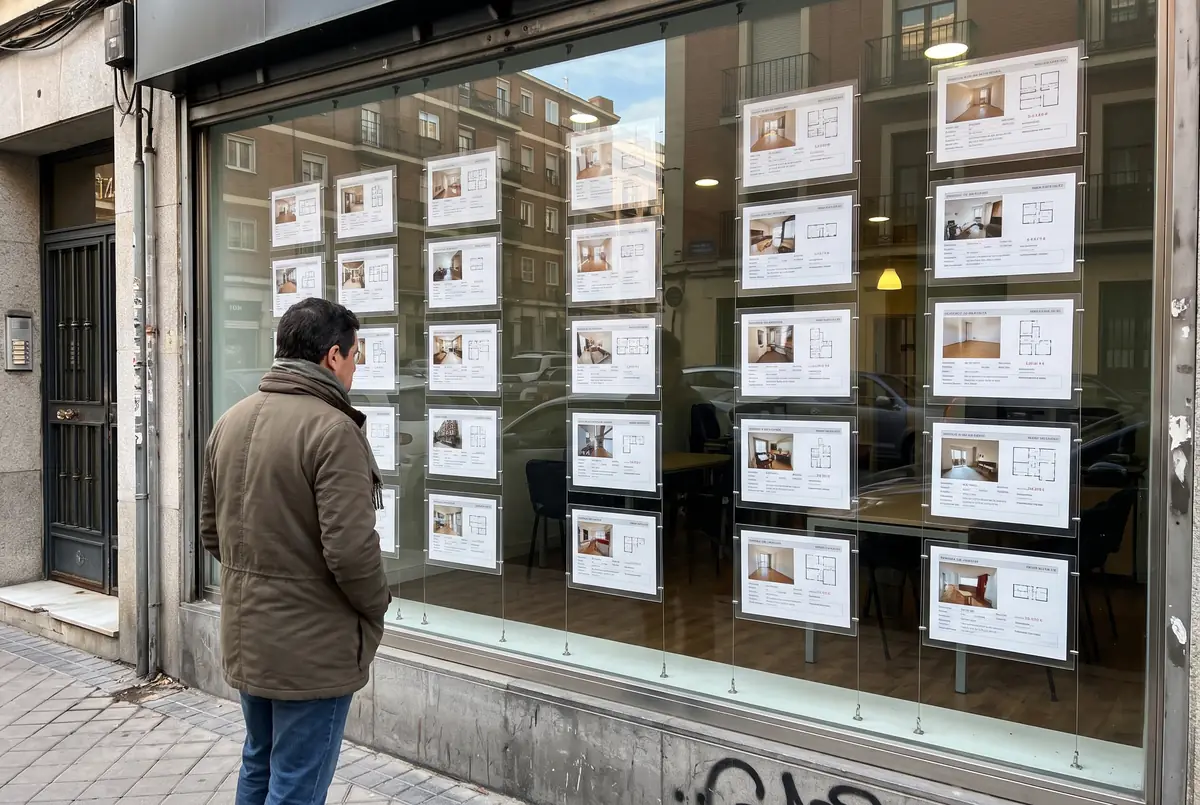
Turning an empty ground-floor shop into a home looks simple: commercial premises usually cost less per square metre than a flat, and on paper the works are just another refurbishment. In practice it depends on three things you cannot see from the street: what the General Plan allows in that building and on that street, whether the future home meets the same conditions as any other, and whether the change is processed and registered properly.
In this guide we explain, using the rules published as of 6 November 2026, where the city of Madrid stands after the Plan Reside, what technical requirements apply, what municipal permit you need, what role the owners’ association plays, how the change is registered, what taxes you pay and what to ask the bank. If you want to sell commercial premises as they are, read «Selling Commercial Premises, an Office or a Garage in Madrid in 2026: Prices, Taxes and Paperwork».
The essentials in one minute
- In the city of Madrid, commercial premises can become a home when the main use of the building is residential and the zoning rules for the area do not prevent it. It is not possible, among other cases, in entire non-residential buildings, in premises listed in the catalogue of commercial establishments or on the 27 commercial street sections of the Plan Reside.
- The premises must be on the ground floor or an upper floor, with no part of the floor below ground level.
- The home must have at least 40 m² of usable floor area and a 2.50 m clear ceiling height, be outward-facing, have windows of at least 12% of each habitable room and comply with the Building Code (CTE).
- In a residential building the usual permit is a declaración responsable (a sworn statement filed with the council); if the works need a full project or the building is protected, a licence.
- The owners’ association does not have to authorise the change of use unless the bylaws expressly forbid it, but it does have to approve works on the façade and common elements; splitting the premises requires three fifths.
- For it to be recorded as a home you need a deed, the Land Registry and the Catastro. When buying the premises you usually pay 6% ITP, or VAT if a company sells and waives the exemption.
What Madrid’s General Plan says today after the Plan Reside
In the city of Madrid the reference is the 1997 General Urban Plan (Plan General de Ordenación Urbana). Since the amendment of its Urban Planning Rules published in the BOCM on 27 November 2023, there has been a specific section on converting commercial premises into homes (articles 7.3.12 to 7.3.16). The Plan Reside, the amendment for the protection and improvement of residential use, changed it in 2025: it was approved by the Comunidad de Madrid on 27 August 2025 (BOCM of 4 September), and the amended articles were published in the BOCM of 22 September 2025.
Commercial premises may be converted into homes when the main use of the building is residential
Urban Planning Rules of Madrid’s General Plan, article 7.3.12.1, as published in the BOCM on 22 September 2025 (our translation)
That is the general rule. As of 6 November 2026, according to the text published in the BOCM, these are the cases where it is not possible or there are limits:
- Buildings used exclusively for non-residential purposes, for example an entire office building: a single unit cannot be converted into a home unless the change of use affects the whole building (art. 7.3.12.2).
- Premises included in the catalogue of commercial establishments, which protects shops for their value, and other premises with use restrictions for heritage reasons (art. 7.3.12.1).
- Areas where planning caps the number of homes: converting premises cannot exceed that maximum (art. 7.3.12.3).
- Commercial streets: the City Council lists 27 sections, outside the historic centre, where converting premises into homes and tourist flats is banned. They include sections of Bravo Murillo, Alcalá, López de Hoyos, Príncipe de Vergara, Marcelo Usera, Méndez Álvaro and avenida de la Albufera.
- Other sections with their own rule: the text published in the BOCM on 22 September 2025 also prevents ground-floor or lower premises from becoming residential on sections of streets such as San Francisco de Sales, Reina Victoria, Raimundo Fernández Villaverde, Francisco Silvela, plaza de Manuel Becerra and Doctor Esquerdo (art. 8.10.2).
- Historic centre: the plan does not authorise converting shops into tourist flats, and in some areas covered by the historic heritage protection zoning it does not allow ground-floor or lower premises to become residential (art. 8.1.32.3).
The list works by sections, not whole streets: premises can be on the same street and outside the section. So before buying or commissioning a project, it is worth requesting the planning information sheet for the plot or making a planning enquiry (consulta urbanística) to the City Council. It saves a lot of trouble.
Is anything in the pipeline that changes this? As of 6 November 2026, what the City Council has approved this year are special plans applying the Comunidad de Madrid’s Law 2/2026 (BOCM of 15 June 2026), designed for plots of offices, hotels or private facilities that become protected rental housing, not for single units in residential buildings. Like any plan, the Plan Reside can be challenged in court or amended: ask your architect to check the rules in force on the day you file.
What about the rest of the Madrid region?
Each municipality has its own General Plan, and some have approved specific rules for commercial premises. One example published this year: Móstoles gave final approval in February 2026 to a special plan with criteria for changing premises into homes (BOCM of 25 March 2026). Among other things, it requires the building’s main use to be residential, bans homes in basements and semi-basements, sets a minimum home of 40 m² of usable floor area and a 2.5 m ceiling height, does not allow converting premises of more than 250 m² and prevents converting ground-floor premises on its commercial streets, with some exceptions.
Technical requirements for the home
Madrid’s Urban Planning Rules say that homes created from commercial premises must meet all the conditions of any other home (art. 7.3.14). They also add conditions specific to the conversion, such as the floor on which the premises are located (art. 7.3.13). These are the figures set by the city of Madrid:
| Requirement | What the rules require in the city of Madrid | Where |
|---|---|---|
| Location of the premises | On the ground floor or an upper floor. Not possible if the floor of the premises is, even partly, below the ground in contact with it, or if there are commercial or leisure premises above | Art. 7.3.13 (and 7.1.4.5) |
| Minimum floor area | 40 m² usable, with living-dining room, kitchen, bedroom and bathroom. Open-plan homes of that size are allowed, except for the bathroom | Art. 7.3.4 |
| Room sizes | Living-dining room of 14 m², kitchen of 7 m², main bedroom of 12 m² (others, 7 m²) and bathroom of 3 m², not accessed from the kitchen or a bedroom | Art. 7.3.4 |
| Ceiling height | 2.50 m in habitable rooms; it may drop locally to 2.20 m. Kitchen and non-habitable rooms, at least 2.20 m | Art. 7.3.5 |
| Outward-facing home | A façade of more than 3 m onto the street, a public open space or a private space on the plot meeting certain dimensions, with at least one habitable room of more than 12 m² opening onto it | Art. 7.3.3 |
| Light and ventilation | Windows of at least 12% of the usable floor area of each habitable room; ventilation according to the health section of the Building Code | Art. 7.3.8 |
| Services | Water, electricity, heating, hot water and drainage, as a minimum | Art. 7.3.16 |
| Parking | If two or more homes are created from the premises, the General Plan’s parking rules apply | Art. 7.3.16.2 |
| Façade | Works on the façade must ensure a result that is consistent with the rest of the building | Art. 7.3.15 |
Source: Urban Planning Rules of the Madrid General Urban Plan, text published in BOCM no. 282 of 27 November 2023, with the changes in the BOCM of 22 September 2025. Other municipalities have their own figures.
The Building Code (Código Técnico de la Edificación, CTE) also applies to changes of use in existing buildings: fire safety, health conditions, noise, energy saving, safety in use and accessibility. If strict compliance is not feasible, the CTE allows some flexibility, but the architect has to justify it.
Before buying, check with an architect what is hardest to solve in ground-floor premises: whether the façade really faces the street or a courtyard of the required size, whether there is enough height left after insulating floor and ceiling, how the bathroom and kitchen will be ventilated, where the downpipes and flues will go, and whether the floor is below pavement level.
Licence or declaración responsable: what you need and who handles it
The Comunidad de Madrid’s Land Law (Law 9/2001, as worded by Law 1/2020) divides planning acts between a licence and a declaración responsable. A licence is required, among others, for works that need a project under general building regulations and for full interventions on listed buildings (art. 152). Changes of use of buildings and installations that do not change the building’s main use, and works that do not require a project, go through a declaración responsable (art. 155).
Applied to commercial premises: in a building whose main use is residential, converting premises into a home does not change the building’s main use. That is why Madrid City Council’s Instruction 1/2020 indicates, for converting premises into homes, a licence for protected buildings or where a project is needed, and a declaración responsable in all other cases. The owner files it with the City Council, together with the architect’s documents, and it takes effect from the day it is registered (art. 157). Works must start within six months and finish within a year (art. 158).
A declaración responsable does not mean nobody checks: the City Council inspects afterwards and, if what was declared does not comply, can declare it ineffective. That is what Madrid City Council proposed in 2026 in a planning enquiry about premises in the Latina district that did not comply with the General Plan.
The owners’ association
The Horizontal Property Law (Ley de Propiedad Horizontal, LPH) does not, in general, require a decision of the owners’ meeting for commercial premises to be used as a home. What you need to look at are the association’s bylaws and the works:
- Bylaws. They may set rules on the use and purpose of flats and premises (art. 5 LPH), and activities forbidden by the bylaws cannot be carried out in the property (art. 7.2). According to Supreme Court case law cited by the Directorate General for Legal Certainty and Public Faith (resolution of 17 October 2025), such restrictions must be stated expressly. And to bind a buyer, they must be recorded in the Land Registry.
- Works inside your premises. You may change the layout and installations of your premises if you do not undermine the building’s safety, its general structure, its exterior configuration or condition, or another owner’s rights, and you notify the chair or the administrator beforehand (art. 7.1).
- Façade and common elements. Opening or enlarging windows, replacing the shop front with a residential façade or running ducts to the roof are works on common elements, and these do need the association’s approval.
- Splitting or joining. Dividing the premises into several homes, joining them with another unit or separating part of them requires a vote in favour by three fifths of all owners who, in turn, represent three fifths of the participation shares (arts. 10.3.b and 17.4 LPH), plus the consent of those affected, unless the bylaws already authorise the owner to do so.
- Shares and costs. If changing the use requires amending the deed of constitution or the bylaws (for example, because commercial premises were exempt from some costs), that change generally needs unanimity (art. 17.6).
When the works are finished: first occupation, Land Registry and Catastro
The habitability certificate (cédula de habitabilidad) no longer exists in the Madrid region: the Comunidad de Madrid abolished it in 2018 and noted that the first-occupation licence is a matter for the town councils. When the works are finished, the architect signs the completion certificate and you must obtain from the City Council the occupation or operation permit that applies. Which document your specific case needs will be confirmed by the City Council: ask when you file your declaration.
Then the change of use has to reach the Land Registry (Registro de la Propiedad). The Directorate General for Legal Certainty and Public Faith treats it as an amendment of the registered new-build declaration, so article 28 of the national Land Law applies. There are two routes:
- With the planning documents: a deed of change of use before a notary, with the municipal permit and the architect’s certificate. The Directorate General has said that a declaración responsable alone is not enough when the act reaches the Land Registry: there must be subsequent control by the City Council, its express approval or approval through inspection (resolution of 25 June 2025, on premises in Madrid).
- By age: if the premises have been used as a home for years without a permit, they can be registered once measures to restore planning legality can no longer be taken. In the Madrid region, the general time limit for the council to act is six years from full completion of the works (fifteen on protected non-developable land), under article 195.1 of the Land Law, in its consolidated text as of June 2026. You also have to prove that the use is not contrary to the plan, and the Directorate General requires a certificate from the municipal planning enforcement body: an architect’s certificate or the Catastro is not enough (resolutions of 25 June 2025 and 30 March 2026).
The Catastro (Spain’s property cadastre) also has to know. A change in the use or purpose of properties or premises that are part of a building is declared to the Catastro, with a document proving the change and its date, within two months from the day after it happens (form 900D). If your town council has opted into the notification scheme, events covered by a municipal licence do not require a declaration by the owner: ask. When the property’s description changes, its cadastral value, which is the basis for IBI (property tax), is reviewed.
Step by step
| Step | Who | What you get |
|---|---|---|
| 1. Prior enquiry | You and your architect, with the City Council | Whether the building, the street section and the floor allow it |
| 2. Feasibility | Architect | Whether a home of 40 m² usable, outward-facing, with 2.50 m height and CTE compliance fits |
| 3. Bylaws and nota simple (Land Registry extract) | You or your lawyer; administrator | Whether there are registered bans and what charges the premises carry |
| 4. Owners’ association approval, if needed | Owners’ meeting | Works on the façade or common elements, or splitting the premises |
| 5. Municipal permit | Owner, with the architect | Declaración responsable or licence |
| 6. Works | Builder and site management | Completion certificate and the applicable occupation permit |
| 7. Deed | Notary | Deed of change of use |
| 8. Land Registry and Catastro | Land Registry; owner or town council | Registration as a home and recording of the new use |
Indicative order. Paperwork and timings depend on the municipality, the building and the works.
Taxes when buying the premises
What you pay when buying depends on who is selling, not on what you plan to do with the premises afterwards:
| Situation | Tax | Rate in the Madrid region |
|---|---|---|
| A private individual sells | ITP (property transfer tax) | 6% general rate for property. The ITP reductions for buying a home do not apply to commercial premises, because for tax purposes what you are buying is commercial premises |
| A company sells second-hand premises | VAT-exempt, ITP applies | 6% |
| A company sells, waives the exemption and you buy as a business entitled to deduct VAT | 21% VAT, declared by the buyer (reverse charge), plus AJD (stamp duty) | AJD of 1.5% on the deed |
| First delivery of new premises by the developer | 21% VAT plus AJD | AJD of 0.75% |
Sources: Law 37/1992 on VAT, arts. 20.Uno.22, 20.Dos, 84.Uno.2.e) and 90 (BOE, consolidated text as of 7 October 2026); Comunidad de Madrid Legislative Decree 1/2010, arts. 28, 35 and 36 (BOE, consolidated text).
If the premises have a Catastro reference value higher than the price, ITP is calculated on that value. The tax return is filed within 30 working days of signing, according to the Comunidad de Madrid. And remember notary, Land Registry and, if used, agency fees: we cover them in «Costs of buying a home in the Madrid region in 2026: taxes, notary, land registry and public aid».
What about 10% VAT? It is for buildings or parts of buildings suitable for use as homes (art. 91.Uno.1.7 of the VAT Law), and what is delivered when you buy is commercial premises. If the seller is a company that has already converted them, it needs to be studied with a tax adviser.
Taxes when you later sell the home
When you sell the home you have created, you will pay the same as on any flat sale:
- IRPF (income tax) on the gain. Under article 35 of the IRPF Law, the acquisition value adds up the price of the premises, the costs and taxes of the purchase and the cost of investments and improvements, such as the conversion works. Keep all the invoices.
- Reinvestment exemption. In ruling V0546-22 of 18 March 2022, the Directorate General for Taxes accepted that a property registered as commercial premises can be a main residence for IRPF purposes if it is fitted out as a home and the other requirements are met, which you will have to prove.
- Plusvalía municipal (municipal capital gains tax on land). It taxes the increase in the value of the land, as in any sale. If there is no gain, it is not paid.
- The buyer pays ITP if you sell as a private individual, and can apply the home-purchase reductions if they meet the requirements, especially if the property is already recorded as a home in the Land Registry and the Catastro.
Bands, exemptions and how plusvalía is calculated are covered in «Taxes When Selling a Flat in Spain in 2026: Plusvalía Municipal in Madrid, Income Tax (IRPF) and Exemptions». If you sell before finishing the conversion, the buyer is buying commercial premises and will know it: describe the real state of the works and the permits.
Value and mortgage: what to check first
There is no official figure for how much converted premises are worth compared with a flat in the same area, and it depends a lot on the case and the neighbourhood: the floor, light, height, privacy from the street, layout and, above all, whether everything is in order. A home registered as such, with its municipal permit and updated Catastro record, is compared with the homes on its street. Premises used as a home without proper paperwork can hardly be compared with them.
The mortgage works in a similar way. No rule sets how much a bank lends on commercial premises: each lender decides its own policy, and mortgage valuations follow Order ECO/805/2003. Before signing a deposit contract (arras), ask the bank three things: whether it finances the purchase of commercial premises and up to what percentage, whether it will value the premises as they are or on the assumption of a finished home, and whether it can also finance the works. The answer often changes the plan.
And think about whoever buys from you later: their bank will value the home and check the nota simple and the Catastro. If the property is still recorded as commercial premises, their mortgage may become complicated. The safest route for a future sale is to complete the whole process: municipal permit, deed of change of use, Land Registry and Catastro.
How we do it at Llavely
At Llavely we sell homes throughout the Madrid region, as well as commercial premises, offices and garages, and we take care of everything: you contact us and we handle the sale from start to finish. We do not process licences or carry out works. What we do, with our specialist lawyers, is review the planning and Land Registry documents before listing: the nota simple, the cadastral certificate, the municipal permit and the deed of change of use if there is one, so you know where your property stands and what to have ready before showing it. We have more than 35 years in the property sector and we review every home in less than 24 hours. The valuation, photos, video, floor plan and virtual tour are included.
Before showing the property we talk to every buyer to find out what they are looking for and how they would pay, and we check their ID before the viewing. We carry out the viewings ourselves and you follow everything from your private seller portal. Our lawyers handle the calculation of the applicable taxes, draft the deposit contract, review the deed and go with you to the notary. You pay 2.5% + VAT of the price, in total, only if you sell and on the day of signing at the notary. If you want to know what your premises, or the home you have made in them, are worth, ask for your free valuation.
Frequently asked questions
Can any commercial premises be converted into a home in Madrid?
No. In the city of Madrid only when the main use of the building is residential and the zoning rules for the area do not prevent it. It is not possible in entire non-residential buildings (unless the whole building changes), in premises listed in the catalogue of commercial establishments, on the 27 commercial street sections of the Plan Reside, or on other sections and in areas of the historic centre where the rules prevent it on the ground floor. The premises must also be on the ground floor or an upper floor and cannot have their floor below ground level.
How many square metres do commercial premises need to become a home?
In the city of Madrid, the minimum home is 40 m² of usable floor area, with living-dining room, kitchen, bedroom and bathroom, or open-plan with a separate bathroom (art. 7.3.4 of the Urban Planning Rules). These are usable, not built, square metres. Other municipalities have their own figures.
Do I need a licence or is a declaración responsable enough?
In a residential building, converting premises is usually processed with a declaración responsable. A licence is needed if the works require a project under building regulations or if the building is protected. The declaration takes effect once registered, but the City Council inspects afterwards and can declare it ineffective if it does not comply.
Does the owners’ association have to give permission?
For the change of use itself, no, unless the bylaws expressly forbid it. Its approval is needed for works on the façade or other common elements, and splitting the premises into several homes needs three fifths of the owners representing three fifths of the participation shares, unless the bylaws already allow it.
My premises have been used as a home for years. Can I register them as a home?
Only if measures to restore planning legality can no longer be taken (in the Madrid region, generally six years after the works were completed) and the use is not contrary to the plan. The Land Registry asks for a certificate from the municipal planning enforcement body: the Catastro or an architect’s certificate is not enough.
What tax do I pay when buying premises to convert them?
If a private individual sells, ITP, which in the Madrid region is 6% for property. If a company sells second-hand premises, also ITP, unless it waives the VAT exemption and you buy as a business entitled to deduct: then 21% VAT and 1.5% AJD. The ITP reductions and 10% VAT are for homes, and what you are buying is still commercial premises.
Sources
- Notice of publication of the amendment to the Urban Planning Rules of the 1997 Madrid General Urban Plan: chapter 7.3, residential use, and conversion of commercial premises into homes (BOCM no. 282, 27 November 2023)
- Agreement of 27 August 2025 of the Governing Council giving final approval to the specific amendment of the Madrid General Urban Plan for the protection and improvement of residential use (BOCM no. 211, 4 September 2025)
- Articles of the Urban Planning Rules amended by the General Plan amendment for the improvement of residential use (BOCM no. 226, 22 September 2025; copy published by the Official College of Architects of Madrid)
- The Plan RESIDE comes into force: no more tourist flats in residential buildings (Madrid City Council, 27 August 2025)
- Special Plan to improve detailed residential zoning and criteria for changing premises into homes, Móstoles City Council (BOCM no. 71, 25 March 2026)
- Law 9/2001 of 17 July on Land in the Comunidad de Madrid, consolidated text: articles 152, 155, 157, 158 and 195 (BOE, last amended 15 June 2026)
- Instruction 1/2020 on the application in Madrid City Council of Law 1/2020 amending the Comunidad de Madrid Land Law (Madrid City Council, Urban Development Department)
- Scope of the Building Code: interventions in existing buildings (Ministry of Housing and Urban Agenda, codigotecnico.org, accessed 6 November 2026)
- Licence for a change of use of a property: project must be drawn up by an architect. Supreme Court judgment 700/2026 of 4 June, cassation appeal 603/2023 (derecholocal.es)
- Law 49/1960 of 21 July on horizontal property, consolidated text: articles 5, 7, 10 and 17 (BOE, last amended 3 October 2026)
- Resolution of 17 October 2025 of the Directorate General for Legal Certainty and Public Faith on bylaw restrictions on use in horizontal property (BOE no. 43, 18 February 2026)
- Resolution of 25 June 2025 of the Directorate General for Legal Certainty and Public Faith on registering a change of use from commercial premises to a home in Madrid (BOE no. 177, 24 July 2025)
- Procedures: cadastral declarations, deadlines and notifications (Directorate General of the Catastro, accessed 6 November 2026)
- Property transfer tax (Transmisiones Patrimoniales Onerosas) (Comunidad de Madrid, Taxpayer service, updated 3 November 2026)
- Legislative Decree 1/2010 of 21 October, consolidated text of the Comunidad de Madrid’s legal provisions on taxes ceded by the State, consolidated text: articles 28, 35 and 36 (BOE)
- Law 37/1992 of 28 December on Value Added Tax, consolidated text: articles 20, 84, 90 and 91 (BOE, last updated 7 October 2026)