Buying & selling · · 24 min read
Should you renovate your flat before selling it or sell it as a renovation project? Madrid in 2026: which repairs are worth it, licence or declaración responsable, 10% VAT, income tax and grants
Painting and fixing what is broken, or a full renovation before selling: there is no official figure for how much the price goes up, but there are clear rules. As of 8 November 2026 we explain which small repairs usually pay off, what permit Madrid City Council requires for each type of work, when the VAT on building work is 10%, what counts for income tax when you sell, which grants are still open and how to present a home that needs renovating.
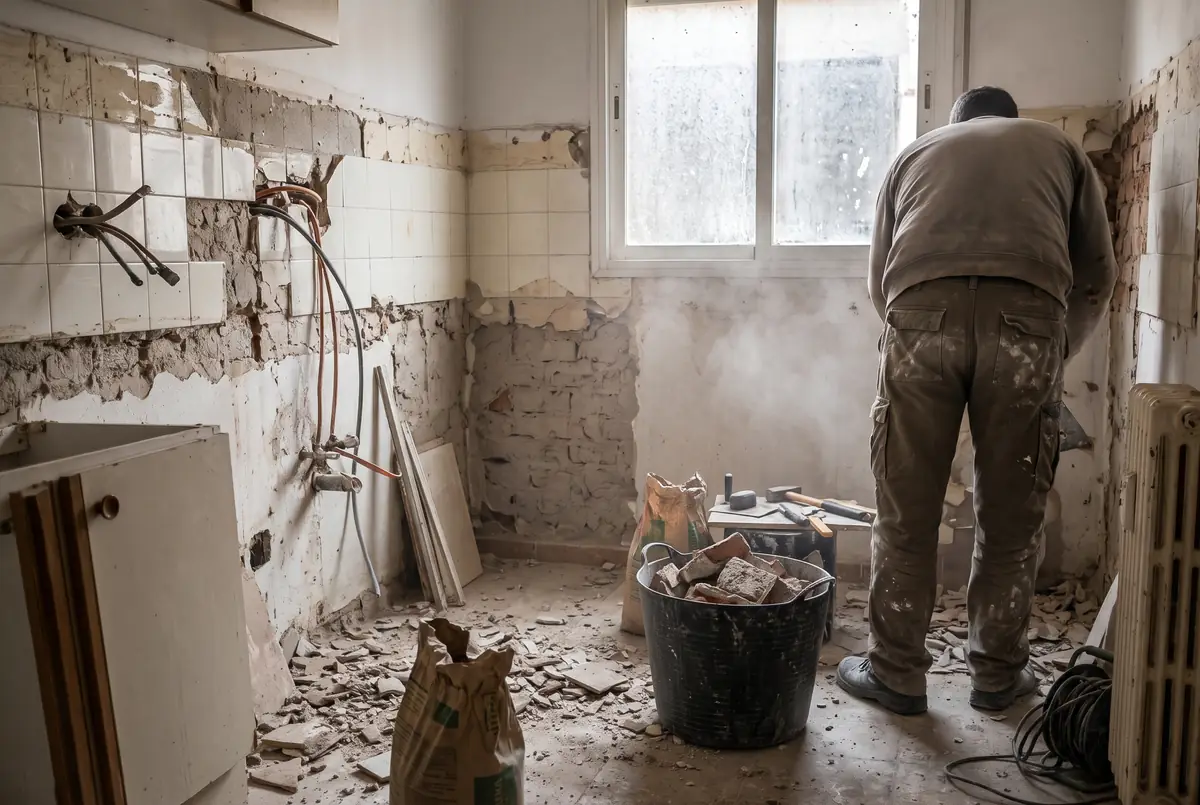
Before putting your home on the market you have probably asked yourself: do I smarten it up, or sell it as it is and let the buyer renovate to their own taste? There is no single answer: it depends on the state of the home, your money and your time, the area and who usually buys there. What does exist are specific rules that change the numbers: which permit the City Council requires, what VAT goes on the invoice, which costs count for income tax when you sell and which grants are open.
We go through it with what has been published as of 8 November 2026, for the Comunidad de Madrid (the Madrid region) and, for permits, for the city of Madrid. You will not find any percentages of added value here: we have not found any official statistic that measures it, and we would rather tell you so than give you an unsupported figure.
The essentials in one minute
- There is no official statistic showing how much a flat’s price rises after renovation. Be wary of any percentage with no source or date.
- Small repairs (painting, fixing what does not work, cleaning, decluttering and good photos) take little time and help buyers see the home rather than a list of jobs to do.
- In the city of Madrid, replacing interior finishes in a single home (paint, floors, tiling, plaster) needs no planning permit if the building is not protected. For bigger interior works a declaración responsable (a self-declaration of compliance) is usually enough; a licence is reserved for works that need a project or protected buildings.
- VAT on the work is 10% if you, as a private individual, commission it for your home, the building is more than two years old and the contractor’s materials do not exceed 40% of the price. Otherwise, 21%.
- For income tax (IRPF), when you sell, improvements are added to what the home cost you and reduce the gain; painting, repairs and upkeep are not. Keep invoices and proof of payment.
- As of 8 November 2026 there is no open call for renovation grants from Madrid City Council or under the EU-funded programmes run by the Comunidad de Madrid.
- If you sell as a renovation project, show the home with a floor plan, information about the building and indicative, dated quotes from professionals. Do not hide defects: the seller is liable for hidden defects.
Renovate or sell as it is: what the data say and what they do not
As of 8 November 2026 we have not found any statistic from the INE (Spain’s National Statistics Institute), the Ministry of Housing or the Comunidad de Madrid that measures how much a home gains in value through renovation; the figures that circulate are usually private estimates. The honest approach is to compare, for your home, what each option costs in money, time and risk.
A clean, bright home with nothing broken comes across better in photos and on a viewing. A full renovation, on the other hand, reflects your taste, not necessarily the buyer’s, and people looking for a flat to renovate usually prefer to do it their way. These are the four usual options:
| Option | What you do | For | Against |
|---|---|---|---|
| Small repairs and good presentation | Paint, fix faults, clean, declutter, photos and floor plan | Little time and money; a planning permit is hardly ever needed; does not limit the buyer | Does not change an old kitchen or bathroom |
| Partial renovation | Replace the kitchen or bathroom, or renew installations | Solves what worries many buyers most | You choose finishes for someone else; may need a declaración responsable; delays the sale |
| Full renovation | Change the layout, renew installations, floors, windows and doors, kitchen and bathrooms | Home ready to move into | More time, money and permits, and the risk that the buyer does not value your choices; no official data on how much is recovered |
| Sell as a renovation project | Sell in its current state, with clear information and indicative quotes | You sell sooner and without works; attracts people who want to renovate their way | The buyer will discount what they think the work will cost: give them data so they do not calculate blindly |
Indicative comparison. What suits you depends on the state of the home, the area and your timetable.
To set the price, start from what is paid in your area for similar homes in a similar condition: we explain it in "How much is my flat worth in Madrid? Price per m² in all 21 districts in 2026 and how to set yours". If the buyer takes out a mortgage, they will need a valuation; we cover it in "Property valuation (tasación) in 2026 when buying or selling in Madrid: who pays, how long it lasts, what happens if it comes in below the price and the latest appraised value".
Small repairs that are usually worth it
These are the ones that show most in photos and on viewings. The idea is not to make the home to your taste, but to remove reasons for doubt:
- Paint in light, neutral colours, especially where there are stains, hairline cracks or very personal colours.
- Small repairs: dripping taps, cisterns, sockets that do not work, stuck shutters, doors that catch, blackened seals.
- Damp: find the cause. If there is a leak, fix it or, if there is no time, explain it and have the quote to hand.
- A deep clean, including windows, kitchen, bathrooms, terrace and storage room.
- Decluttering: remove personal items and surplus furniture, clear hallways and worktops.
- Light: blinds and curtains open for photos and viewings, and light bulbs of the same colour temperature.
- Professional photos, a floor plan with measurements and, if possible, video and a virtual tour.
- Paperwork ready: the energy performance certificate, which is compulsory to advertise, and the other documents, listed in "Documents Needed to Sell a Flat in Madrid in 2026: Full Checklist, Where to Get Them and What They Cost".
Why do they work? Because buyers make a list, consciously or not, of what they will have to fix, and every small defect they see makes them think of others they cannot see. In addition, in the city of Madrid most of these repairs need no permit, as you will see below, and they take days.
When a bigger renovation can make sense
A few questions to help you decide whether to carry out work before selling:
- Is there something that prevents normal use of the home, such as wiring that trips or a boiler that does not work? That is worth fixing or, at least, getting a quote for.
- Do you have time? Quotes, permit, works and cleaning delay the sale, and building work often overruns.
- Do you have the money without borrowing? If you need a loan, add its costs.
- Who buys in your area? If it is usually people who want to move straight in, a finished home may sell better; if it is usually people looking to renovate their way, perhaps not.
- Is the building protected or does the work need a project? Then a licence will be needed, and timescales grow longer.
If in doubt, ask for two or three quotes with no obligation: they help you decide and, if you sell without renovating, you can show them to the buyer.
Licence, declaración responsable or nothing: building work in the city of Madrid
In the city of Madrid, building work is governed by Ordinance 6/2022 of 26 April on Planning Licences and Declarations of Compliance (known as OLDRUM), in force since 17 June 2022, according to the law firm EY. Some works need no permit at all, some need a declaración responsable (you declare, usually with a technical professional, that you comply with the rules and can start without waiting for authorisation) and some need a licence (the City Council authorises beforehand).
The general rule is the declaración responsable. According to EY, no planning permit at all is needed for interior finishing work in a single home or commercial unit, if it is not protected, or for renewing lawful installations that keep the same requirements, the same position and similar dimensions. The City Council’s Instruction 1/2020 already left the replacement of interior finishes in a single home (flooring, tiling, plaster and paint) without a permit, under article 160.f of the Comunidad de Madrid Land Act. These are the most common cases:
| Work | What Madrid City Council requires | Where it comes from |
|---|---|---|
| Painting, replacing floors or tiles, plaster, in a single home in an unprotected building | No planning permit | Land Act, art. 160.f, according to Instruction 1/2020; OLDRUM, according to EY |
| Renewing lawful installations in the same position and with similar dimensions | No planning permit | OLDRUM, according to EY |
| Localised refurbishment of the home, even if the interior layout changes, without opening or enlarging openings in load-bearing walls or touching the structure | Declaración responsable | Instruction 1/2020, section 4.2 |
| General refurbishment or partial restructuring | Declaración responsable, unless the building is protected or a project is needed | Instruction 1/2020 |
| Works that need a technical building project | Licence | OLDRUM, according to EY; Instruction 1/2020 |
| Works on listed buildings that are a total intervention or affect protected elements | Licence | Instruction 1/2020; OLDRUM, according to EY |
| Changing the exterior composition of the façade | Licence; if openings are only modified without essential change or a project, declaración responsable | Instruction 1/2020 |
Instruction 1/2020 was drafted under the previous ordinance: confirm your case with the City Council or your technical professional. In other municipalities, their own ordinance applies.
"Minor works" and "major works" (obra menor and obra mayor) are common expressions, but the Madrid ordinance is organised by type of work, project and protection of the building. And a declaración responsable is not a mere notice: the City Council can check what was declared afterwards and, according to EY, the end of the works must be reported so that they can be verified. Work without a permit, or different from what was declared, can hold up the sale. We explain it in "Selling a detached, semi-detached or terraced house in Madrid in 2026: price, plot, Catastro, undeclared building work, licences, pool, well and housing estate" and, for changes of use, in "Converting commercial premises into a home in Madrid in 2026: where it is allowed, requirements, licence or declaración responsable, owners’ association, Land Registry, taxes and mortgage".
Building work also has a municipal cost. According to the Madrid municipal tax agency (Agencia Tributaria Madrid), the Tax on Constructions, Installations and Works (ICIO) is self-assessed when the declaración responsable is filed, or within the month after the licence is granted; when the work is finished, the final cost must be declared within a month, with invoices or the end-of-works certificate. Work done without a permit is also taxed, and accessibility works for people with disabilities have a 90% rebate. The amount depends on the tax ordinance: ask your technical professional before budgeting.
And do not forget the owners’ association. The Horizontal Property Act allows you to modify the architectural features, installations or services of your flat as long as you do not undermine or alter the building’s safety, its general structure, its exterior configuration or condition, or harm another owner, and it requires you to notify the person representing the association beforehand (article 7.1, as worded by Act 8/1999). Tell the chair or the property manager and ask about working hours and removal of debris.
VAT on building work: when it is 10%
Renovation and repair work on a home can carry 10% VAT instead of 21% (article 91.Uno.2.10.º of the VAT Act). According to the Spanish Tax Agency (VAT rates 2026), three requirements apply:
- The person commissioning the work must be an individual who uses the home for private purposes, or an owners’ association.
- The construction or last refurbishment of the home must have been completed at least two years before the work begins.
- The contractor must not supply materials, or their cost must not exceed 40% of the taxable amount of the transaction. According to the Tax Agency, materials are goods that become part of the building, such as bricks, lime, sand or plaster; machinery and tools are not.
According to the Tax Agency’s frequently asked questions (13 October 2026), the invoice must state the cost of materials or record that the limit is met, and splitting the job into a materials invoice at 21% and a labour invoice at 10% is not allowed. Ask the contractor how they calculate the share of materials before signing.
| Situation | VAT on the work |
|---|---|
| Your home, for your private use, more than two years old and materials up to 40% | 10% |
| The materials supplied by the contractor exceed 40% of the taxable amount | 21% |
| Rented home, work paid for by the owner (until 30 November 2026) | 21%, because the use is not private, according to the Tax Agency |
| Home intended to be let as a main residence (from 1 December 2026, if Royal Decree-law 29/2026 is ratified) | 10%, with the same age and materials requirements |
| Maintenance of lifts, boilers or electrical installations | 21%, because it is not building work |
| Work on a swimming pool | 21%, because it is not considered housing |
Sources: Spanish Tax Agency, VAT rates 2026; FAQs on building work and repairs (13 October 2026); bulletin on Royal Decree-law 29/2026.
What if the home is empty because you are going to sell it? The requirements refer to private use by the person commissioning the work. If you no longer live there or you inherited it and nobody uses it, ask your tax adviser before accepting a quote at 10%.
What counts for income tax when you sell
When you sell you pay income tax (IRPF) on the gain: the difference between what you get and what the home cost you. The Income Tax Act (article 35, consolidated text as of 7 October 2026) says that the acquisition value is the sum of the actual purchase price and the "cost of the investments and improvements made to the assets acquired", plus the purchase costs and taxes you paid, excluding interest. The selling costs and taxes you pay are deducted from the sale price.
The key is to tell improvements from upkeep. According to a ruling by the Directorate General for Taxation of 15 February 2019, reported by the CEF, improvements are works that increase the capacity or habitability of the property or extend its useful life, and they are added to the acquisition value. Repairs and upkeep, which keep the home in its normal condition, are not. The Central Economic-Administrative Court (TEAC), in a decision of 25 September 2023, added two nuances: calling a job a "full renovation" does not in itself make it an improvement, and replacing elements that already existed, such as renewing a kitchen that was already there, is upkeep. Each item has to be looked at.
| Expense | Does it reduce the gain for income tax? |
|---|---|
| Works that increase capacity or habitability or extend useful life (improvements) | Yes: added to the acquisition value, if you can prove them |
| Painting, small repairs, cleaning, getting the home ready | No: they are upkeep |
| Replacing an element with an equivalent one (for example, changing a kitchen that already existed) | No, according to the TEAC’s 2023 criterion |
| Purchase costs and taxes you paid, excluding interest | Yes: they form part of the acquisition value |
| Selling costs and taxes you pay | Yes: deducted from the transfer value |
Income Tax Act 35/2006, art. 35; Directorate General for Taxation ruling of 15-2-2019 and TEAC decision of 25-9-2023, according to the CEF. If the home was let, depreciation reduces the acquisition value.
The burden of proof is yours: according to the TEAC, you must be able to justify the work and its cost to the tax authorities. Keep detailed invoices, proof of bank payment and, if there is one, the declaración responsable or the licence. Exemptions, such as reinvestment in a main residence or the one for people over 65, are covered in "Taxes When Selling a Flat in Spain in 2026: Plusvalía Municipal in Madrid, Income Tax (IRPF) and Exemptions".
Energy performance certificate and renovation
According to the Comunidad de Madrid, which applies Royal Decree 390/2021, homes that are sold or let must have an energy performance certificate, and the label must be included in any brochure, offer, promotion or advertising for the sale. It is valid for a maximum of ten years, or five if the rating is G; the owner is responsible for renewing or updating it and registering it in the Comunidad’s register, which is done online.
If you carry out work that may change the rating (windows, insulation or boiler, for example), it makes sense to certify afterwards, so that the certificate reflects the home as it ends up. The Comunidad also says a certificate is required for certain renovations, such as those affecting more than 25% of the surface. What it costs and how long it takes are covered in "Energy Performance Certificate to Sell a Flat in Madrid in 2026: Who Issues It, What It Costs, How Long It Takes and What Happens Without One".
Renovation grants in Madrid: what is open as of 8 November 2026
Renovation grants usually go to whole buildings and energy efficiency, through calls with deadlines. As of 8 November 2026, the main ones stand as follows:
| Grant | What for and who for | Status as of 8-11-2026 |
|---|---|---|
| Plan Rehabilita Madrid 2026 (Madrid City Council) | Accessibility, upkeep, energy efficiency, health and safety in residential buildings. Owners’ associations, grouped owners and owners of single-family houses, among others. €50 million | Closed: applications from 3 June to 30 September 2026 (BOCM no. 129, 2 June 2026) |
| Programmes 3, 4 and 5 for energy renovation with EU funds (Comunidad de Madrid) | Residential buildings (3), homes (4) and building logbook and projects (5) | Closed. Programme 4 was declared finished by the Order of 14 July 2026 (BOCM of 28 July). Page updated on 27 October 2026 |
| Income tax deductions for energy-efficiency improvement works | Main residence or let home and residential buildings | They applied in the 2025 tax return. The extensions for 2026 were in Royal Decree-laws 16/2025 and 2/2026, which the Tax Agency lists as not ratified: check with an adviser before counting on them |
Sources: BOCM; Comunidad de Madrid; Spanish Tax Agency. We have not found any other call open as of 8 November 2026 for works inside a home in the city of Madrid.
If your owners’ association already has a grant or has approved work on the building (façade, lift, roof), tell the buyer, ask the property manager for a certificate of what has been approved and of any outstanding levies (derramas), and put it in writing in the arras (the deposit contract). For new calls, keep an eye on the BOCM (the Comunidad de Madrid’s Official Gazette) and the Official Gazette of Madrid City Council (BOAM).
Renovating with the home on the market: timescales and risks
The simplest thing is to finish the repairs before advertising. If not, bear these risks in mind:
- Viewings with dust and noise: the home looks worse than before you started. Better to pause viewings while the work lasts.
- Photos that stop being accurate: if you change something important, redo the photos, floor plan and virtual tour.
- Timescales that overrun: do not agree a handover date with a buyer that depends on the work being finished.
- Work agreed in the arras: if the buyer asks you to fix something before the deed, put in writing what, to what standard, who pays and what happens if it is not ready in time.
- Work without a permit: the buyer, their lawyer or the notary may ask. Keep the declaración responsable or the licence to hand.
- Guarantees: ask for a detailed invoice and a guarantee for the work and hand them over to the buyer.
A sensible order, if you decide to repair before selling:
- Get a valuation of the home as it is.
- Make a short list: first what does not work, then what shows.
- Ask for two or three quotes with itemised costs, VAT shown separately and cost of materials.
- Check whether the work needs a permit and notify the owners’ association.
- Do the work and keep invoices, proof of payment and guarantees.
- Clean, declutter and update the energy performance certificate if the work has changed the home.
- Advertise with photos, floor plan, video and virtual tour.
Selling as a renovation project: how to present a home that needs work
Selling without renovating is a good option, especially if the home needs major work or you do not have time to manage it. The key is for the buyer to calculate with data rather than by eye, because by eye they tend to aim high. What helps most:
- A floor plan of the current state with measurements and, if you like, a layout proposal by an architect, clearly presented as a proposal.
- Indicative quotes from professionals, dated, itemised and stating whether VAT and permits are included. They are a reference: the buyer will get their own.
- Information about the building: year of construction, whether it is protected, the technical inspection, approved works or outstanding levies.
- What you know about the installations, such as the age of the boiler or the wiring.
- Real, well-lit photos: the home on the viewing must be the one in the photos.
- Making it easy to come back for a second viewing with their architect or builder.
- An honest listing: "to renovate" attracts people looking for exactly that.
That way the buyer can plan their work and make you a considered offer, without over-discounting out of fear of the unknown.
How we do it at Llavely
At Llavely we sell homes throughout the Comunidad de Madrid and take care of everything: you get in touch and we handle the sale from start to finish. We review every property in under 24 hours and the valuation is included. We do not carry out building work or renovations, but we do tell you, with the home in front of us, which small repairs are worth doing before the photos and what is better explained clearly. Photos, video, floor plan and virtual tour are included, also when the home is sold as a renovation project.
Before showing your home we talk to each buyer to understand what they are looking for and how they would pay, and we check their ID before the viewing. We carry out the viewings ourselves and you follow everything from your private seller portal. Our specialist lawyers review the nota simple (the Land Registry summary) and the paperwork, prepare the calculation of the taxes that apply, draft the arras, with any clauses needed if work has been agreed or there are levies in the building, and accompany you to the notary’s office.
You pay 2.5% + VAT of the price, in total, only if you sell and on the day of signing at the notary’s office. We do not promise timescales or increases in value: we give you data to decide. If you would like to know what your home is worth as it is, request your free valuation: we give you a range straight away and then call you, see the home and fine-tune the price.
Frequently asked questions
Is it worth renovating a flat before selling it?
It depends on the state of the home, your time and the area; there is no official statistic on how much the price rises after renovating. Small repairs (painting, fixing, cleaning, decluttering and good photos) usually pay off because they cost little and remove buyers’ doubts. A full renovation is more expensive and slower, and the buyer may not value your choices.
Do I need a licence to paint or change the floor in Madrid?
In the city of Madrid, replacing interior finishes in a single home, such as paint, floors, tiling or plaster, needs no planning permit if the building is not protected (Land Act, art. 160.f, according to Instruction 1/2020; OLDRUM, according to EY). Other interior works usually go through a declaración responsable, and those that need a project or affect protected buildings require a licence. In other municipalities, check their ordinance.
What is the difference between a declaración responsable and a licence?
With a declaración responsable you declare, usually with a technical professional, that the work complies with the rules, and you can start without waiting for authorisation; the City Council checks afterwards. With a licence, the City Council reviews and authorises before you start. In Madrid, the general rule is the declaración responsable.
When is VAT 10% on a renovation?
When it is commissioned by an individual for a home they use privately (or by an owners’ association), the home is at least two years past its construction or refurbishment and the contractor’s materials do not exceed 40% of the taxable amount (VAT Act, art. 91.Uno.2.10.º). Otherwise, 21%.
Can I deduct the renovation from my income tax when I sell the flat?
Improvements, yes: they are added to the acquisition value and reduce the gain (Income Tax Act, art. 35). Improvements are works that increase capacity or habitability or extend useful life. Painting, repairs and replacing what was already there with something equivalent are upkeep and do not count. You need invoices and proof of payment.
Are there grants to renovate my flat in Madrid now?
As of 8 November 2026 there is no open call under Madrid City Council’s Plan Rehabilita (it closed on 30 September) or under the Comunidad’s EU-funded energy renovation programmes. Income tax deductions for energy efficiency for 2026 works depended on decrees that were not ratified: check with an adviser.
How do I sell a flat that needs renovating?
With information: a floor plan of its current state, details of the building, dated indicative quotes from professionals and an honest listing. That way the buyer calculates with data and does not over-discount. Do not hide defects: the seller is liable for hidden defects and the buyer has six months from handover to claim.
Sources
- Act 35/2006 of 28 November on Personal Income Tax, consolidated text: article 35 (BOE – Spain’s Official State Gazette, last updated 7 October 2026)
- Act 8/1999 of 6 April amending Act 49/1960 on Horizontal Property: article 7.1 (BOE no. 84, 8 April 1999)
- VAT rates 2026 (Spanish Tax Agency, document of 26 February 2026)
- Frequently asked questions on building work and repairs to property (Spanish Tax Agency, updated 13 October 2026)
- Royal Decree-law 29/2026 of 6 October: tax changes in VAT and income tax (Spanish Tax Agency, information bulletin, October 2026)
- Note on Royal Decree-laws 16/2025 and 2/2026, not ratified (Spanish Tax Agency, 2026)
- Extract of the call for grants Plan Rehabilita Madrid 2026 (Madrid City Council, BOCM no. 129, 2 June 2026)
- Grants for energy renovation of residential buildings and homes, PRTR (Comunidad de Madrid, updated 27 October 2026)
- Energy performance certificate for homes (Comunidad de Madrid, updated 4 April 2025)
- Instruction 1/2020 on the application in Madrid City Council of Act 1/2020 amending the Comunidad de Madrid Land Act (Madrid City Council, Urban Development Department)
- Tax on Constructions, Installations and Works (ICIO): frequently asked questions (Agencia Tributaria Madrid, consulted on 8 November 2026)
- Approval of Madrid City Council’s Ordinance on Planning Licences and Declarations of Compliance (EY Abogados, legal alert, 24 May 2022)
- Improvements, extensions and upkeep and repair costs: what is added to the acquisition value for capital gains (CEF, fiscal-impuestos.com, 29 April 2019)
- Does any full renovation increase a home’s acquisition value? TEAC decision of 25 September 2023 (CEF, fiscal-impuestos.com, 29 November 2023)
- Action for hidden defects in the sale of a home (Sepin, 30 June 2020)
- Congress will vote on the housing decrees on 12 November (El Demócrata, 4 November 2026)