Buying & selling · · 24 min read
Selling an inherited flat between siblings who disagree in Madrid in 2026: joint ownership, who must sign, buying out the others, selling only your share, court-ordered division and taxes
When several siblings inherit a flat and not all of them want the same thing, the law offers ways out. As of 7 November 2026, we calmly explain who has to sign, why nobody is obliged to remain a co-owner, the five options (selling together, one sibling keeping the flat, one buying another's share, selling only your share, or court-ordered division with an auction), what happens if one of you lives in the home, and who pays the plusvalía, income tax (IRPF) and AJD in the Comunidad de Madrid.
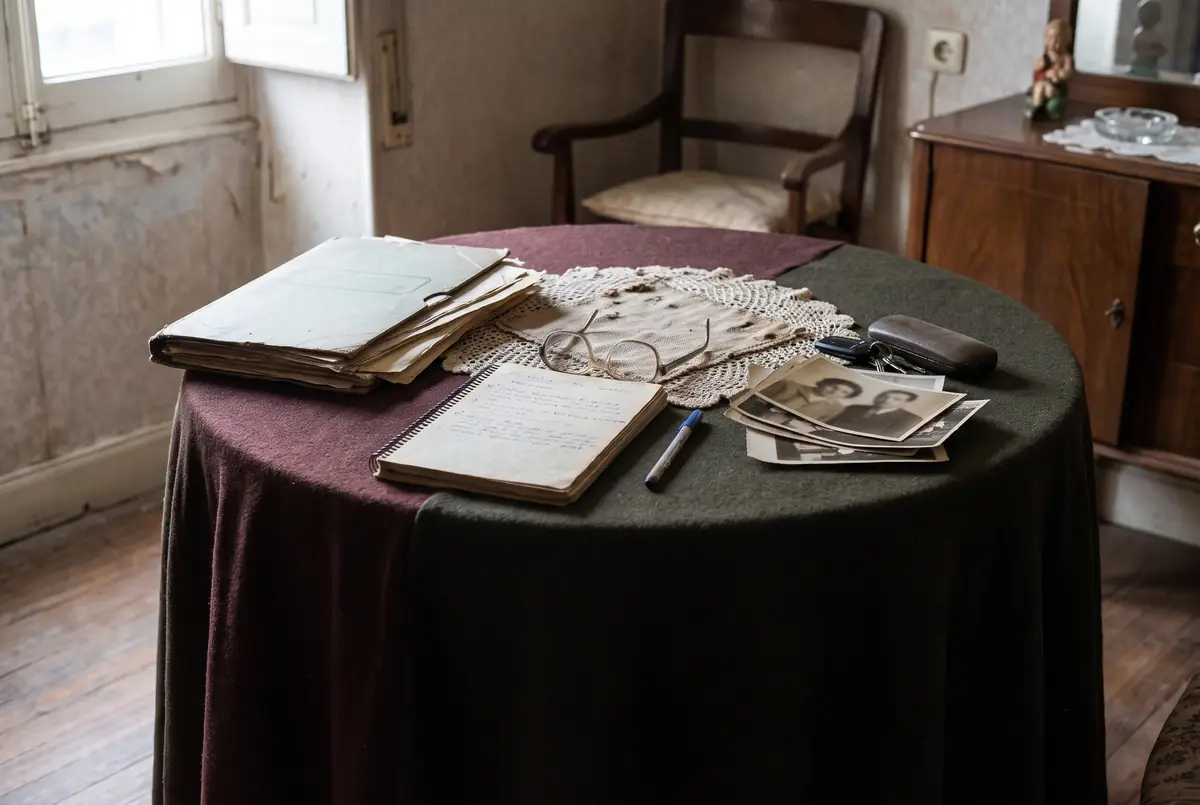
Inheriting your parents' home together with your brothers and sisters stirs up a lot at once: grief, memories and a practical decision that several people have to make together. Sometimes everyone sees it the same way. Other times, one wants to sell as soon as possible, another would rather wait, another lives there or wants to keep it, and someone lives far away and can barely get involved. None of these positions is wrong. They are different, and the law has rules designed precisely for when there is no agreement.
Here we explain, under the rules published as of 7 November 2026, where you stand legally, who has to sign, the five possible options, what happens if one of you uses the home and which taxes apply on each path in the Comunidad de Madrid. The general procedures are covered in "Selling an Inherited Flat in Madrid (2026): Steps, Taxes and What to Do If There Are Several Heirs"; the cost of the inheritance in "How much does it cost to inherit a property in Madrid in 2026? Notary, Land Registry, taxes and lawyer"; and, if there was no will, in "Inheritance without a will in Spain in 2026: who inherits, declaration of heirs, cost and deadlines".
The essentials in one minute
- Before the estate is divided (the partición), you share an undivided inheritance (comunidad hereditaria) over the whole estate. Once the flat has been allocated to all of you, you are co-owners in joint ownership (proindiviso), each with a percentage.
- To sell the whole flat, everyone has to sign. To manage it, for example to let it for less than six years, a majority of the shares is enough.
- Nobody is obliged to remain a co-owner: anyone can ask for division at any time. If the flat cannot be divided and there is no agreement, it is sold and the price is shared out.
- If one of you lives in the home without the others' agreement, the Spanish Supreme Court has said that this exclusive possession is not protected.
- When selling to a third party, each sibling pays their share of the plusvalía and declares their gain for income tax (IRPF) from the value of the inheritance. If one keeps the flat, the usual tax is AJD (0.75% in Madrid) on the part they acquire.
- Before selling, the inheritance must be formalised in a deed and the Inheritance Tax and the plusvalía filed: without that, the Land Registry will not register it.
First, where do you stand?
As long as the inheritance has not been divided, the heirs share an undivided inheritance: you jointly own the whole (the flat, the accounts, the debts) and nobody yet has a specific percentage of the flat. The Supreme Court summed it up in its judgment 1576/2024 of 20 November: until the division, «no existe propiedad exclusiva de ninguno de los herederos sobre ninguno de los bienes» (none of the heirs has exclusive ownership of any of the assets). When you sign the deed of acceptance and allocation and the flat is allocated to all of you, you become co-owners:
Hay comunidad cuando la propiedad de una cosa o un derecho pertenece pro indiviso a varias personas. (There is joint ownership when the ownership of a thing or a right belongs undivided to several people.)
Spanish Civil Code, article 392
To find out which applies to you, check whether the inheritance deed exists and request a nota simple (Land Registry extract). According to the guide published by the Spanish Association of Land Registrars, the nota simple gives information on the property, its owners and its charges, such as mortgages or life interests. If your father or mother is still listed as owner, the inheritance has not been registered.
| Undivided inheritance | Joint ownership (proindiviso) | |
|---|---|---|
| When | From the death until the estate is divided | After the flat has been allocated to all of you |
| What each person has | A share of the whole estate, with no specific assets | A percentage of the flat |
| How to exit | Division of the estate: by agreement, through an executor-partitioner or in court | Sale, buyout (extinción de condominio) or action for division |
| If one sells to an outsider | Co-heirs' right of redemption: one month from notification (art. 1067) | Co-owners' right of redemption: nine days (arts. 1522 and 1524) |
| Main rules | Civil Code, arts. 1051 to 1067 | Civil Code, arts. 392 to 406 |
Source: Civil Code, BOE consolidated text (consulted on 7 November 2026). Article 406 applies the rules on dividing an inheritance to joint ownership.
Do we all have to agree in order to sell?
To sell the whole flat, yes. Article 398 of the Civil Code says that, for the management and better enjoyment of the jointly owned property, majority decisions are binding, with the majority counted by shares, not by people. Article 397 prevents anyone from making alterations to the jointly owned property without the consent of the others. And article 399 gives each co-owner full ownership of their share: they can sell it, assign it or mortgage it, but only that share.
According to the analysis of case law published by Sepín, a Spanish legal publisher, letting for less than six years is mere management (a majority is enough), whereas a lease of more than six years or the sale of the whole property are acts of disposal and require unanimity. If someone sells the whole flat without the others, court rulings are not uniform: some consider the sale void, others hold that it only binds those who consented. If there is no majority, or the majority's decision seriously harms the others, article 398 allows you to ask a judge to decide, even by appointing an administrator.
Needing unanimity does not mean that one person can block the situation for ever:
Ningún copropietario estará obligado a permanecer en la comunidad. (No co-owner shall be obliged to remain in joint ownership.)
Spanish Civil Code, article 400
The same article allows an agreement not to divide for a maximum of ten years, renewable by a new agreement. For inheritances, article 1051 says that no co-heir can be forced to remain in undivided ownership unless the deceased expressly prohibited division, and article 1965 says that the action to request the division of an estate or of jointly owned property does not lapse.
The five options at a glance
| Option | What it takes | The upside | Points to bear in mind |
|---|---|---|---|
| 1. All sell together to a third party | Everyone signs the arras (reservation contract) and the deed | Usually the best price and the cleanest route | You need to agree on price, offers and costs |
| 2. One keeps the flat and pays the others | An agreed valuation and cash or a mortgage from whoever keeps it | The home stays in the family | AJD on the part acquired; possible income tax for those who are paid |
| 3. One buys another's share and the rest remain co-owners | Agreement between the one leaving and the one buying | Only the person who needs to leaves | The Supreme Court treats it as a transfer: 6% ITP in Madrid |
| 4. Selling only your share | A buyer for a percentage | Does not depend on the others | Few buyers; the others can take the share over (right of redemption) |
| 5. Court-ordered division and auction | A prior attempt at negotiation, a lawyer and a court representative (procurador) | Breaks the deadlock | Slow, costly and at a price nobody controls |
Summary for guidance based on the rules and case law cited in this article.
Option 1: all sell together to a third party
If you agree on selling, even if not on everything else, it is worth putting the ground rules in writing before showing the home.
- Asking price and minimum price, starting from a valuation that works for all of you.
- Who approves offers, bearing in mind that the final signature has to come from everyone.
- Who talks to buyers, the notary and the bank, so that you do not send mixed messages.
- How IBI (council tax on property), community fees and utilities are shared until the sale. Profits and charges are shared in proportion to the shares (art. 393), and anyone can make the others contribute to maintenance costs (art. 395).
- What happens to the furniture and who clears the home.
- If someone cannot attend the notary's office, they can sign through a notarial power of attorney.
All the sellers sign the arras and the deed. The money is shared according to each person's percentage and, if there is a mortgage left, it is cancelled at the same notary's office.
Option 2: one keeps the flat and pays the others
If you have not yet divided the inheritance, this can be done in the division itself: article 1062 of the Civil Code provides that, when a thing is indivisible or loses a lot of value if divided, it can be allocated to one of the heirs, who pays the others the excess in money. If the flat is already in all your names, the operation is called extinción de condominio (ending joint ownership) and is signed before a notary. The most delicate point is the value: it helps to start from a valuation nobody can dismiss as biased. And if there are other assets in the estate, you can sometimes offset with them and pay less in cash.
For tax purposes, sharing out what was already jointly owned is not the same as selling to a third party. According to the Supreme Court, in a judgment of 9 October 2018 explained by the law firm Andersen, dissolving joint ownership is taxed, when formalised in a deed, under the graduated AJD (Impuesto sobre Actos Jurídicos Documentados, stamp duty on notarial deeds), and only on the part acquired: the person keeping the flat cannot be taxed for acquiring what was already theirs. In the Comunidad de Madrid, the general AJD rate for deeds with no specific rate is 0.75% (article 36 of Legislative Decree 1/2010).
An example for guidance, calculated by us: three siblings inherit equal shares of a flat they value at €300,000 and one keeps it. They acquire their siblings' two thirds, €200,000. At 0.75%, AJD would be €1,500, before any relief that might apply.
And the plusvalía municipal? According to the Directorate-General for Taxation (ruling V0239-16, explained by GTT), if the property is indivisible, the cash compensation is not an excess allocation and the tax does not apply; if the excess could have been avoided, it does. For income tax (IRPF), the person who is paid may have to declare a gain: in a judgment of 10 October 2022 discussed by AEDAF (the Spanish association of tax advisers), the Supreme Court held that compensation paid to the co-owner who does not keep the property generates a capital gain when its value has been updated since it was acquired. For an inherited flat, that acquisition is the inheritance: if the value you agree now is higher than the one declared then, the difference may be taxed. We explain the same situation for a separating couple in "What to do with the home in a divorce or separation in Madrid in 2026: selling, buying out the other’s share, community property, use of the family home, mortgage and taxes".
Option 3: when one leaves and the others remain
There are four siblings, one needs the money and two others buy their share, and the home is still owned by three. It looks like an extinción de condominio, but for tax purposes it is not. In a judgment of 26 June 2019 (appeal 4322/2017, analysed by Gómez-Acebo & Pombo), the Supreme Court concluded that the joint ownership is not ended but modified, continuing with fewer co-owners, and that the operation is taxed as an onerous property transfer, with a dissenting opinion. In the Comunidad de Madrid, the general ITP rate for real estate is 6% (article 28 of Legislative Decree 1/2010).
Option 4: selling only your share
Each co-owner can sell their percentage without asking permission (article 399 of the Civil Code). It is legal, but few people want to buy part of a home they will not be able to use freely, and the seller should expect this to be reflected in the price.
In addition, your siblings have priority. If you sell to an outsider, any of them can exercise the co-owners' right of redemption (retracto de comuneros, article 1522): step into the buyer's shoes on the same terms (article 1521), reimbursing the price and the legitimate expenses (article 1518). If several of them do so, each does it in proportion to their share. The deadline is nine days from registration in the Land Registry or, if the sale is not registered, from when they learn of it (article 1524). Before the estate is divided, if what is sold is the inheritance share, co-heirs have one month from notification (article 1067). The sensible approach is to offer your share to your siblings first, in writing and with a price, and then to notify them of any sale to a third party and its terms.
Option 5: court-ordered division and auction
If there is no way to agree, anyone can go to court. Before the estate has been divided, you ask for the court-ordered division of the inheritance: article 1059 of the Civil Code says that, if the heirs cannot agree on how to divide, their right remains intact to be exercised under the Civil Procedure Act. If the flat is already jointly owned by all of you, you bring an action for division of jointly owned property.
There is a compulsory step before filing a claim. Organic Law 1/2025 establishes that, in civil matters and as a general rule, for a claim to be admitted you must first have used an appropriate dispute resolution method on the same subject (article 5). The law mentions direct negotiation or negotiation through lawyers, mediation, private conciliation, a confidential binding offer and the opinion of an independent expert.
If it goes to trial and the flat cannot be divided, article 404 provides that, if the co-owners do not agree to allocate it to one of them compensating the others, it is sold and the price is shared out. For inheritances, article 1062 is even more direct:
bastará que uno solo de los herederos pida su venta en pública subasta, y con admisión de licitadores extraños (it shall suffice for just one of the heirs to request its sale at public auction, with outside bidders admitted)
Spanish Civil Code, article 1062
Court and notarial auctions are held electronically on the Auction Portal of the Spanish Official State Gazette Agency (Agencia Estatal BOE). According to Royal Decree 1011/2015, to bid you must register as a user and, when the law requires it, lodge a deposit of 5% of the value of the assets. People outside the family can bid, nobody controls the final price and, before sharing out, the costs of the proceedings have to be deducted: lawyer, procurador and often an expert valuer. That is why it works better as a last resort than as a goal.
If one of the siblings lives in the flat
It is a common and painful situation, often involving the sibling who cared for your parents. Article 394 of the Civil Code allows each co-owner to use jointly owned property according to its purpose, but without harming the joint ownership or preventing the others from using it according to their rights.
In judgment 1576/2024, the Supreme Court looked at the case of four siblings who had inherited a house without dividing the estate, one of whom lived in it, and confirmed that the others could ask for his eviction as an occupier on sufferance (desahucio por precario). Being a co-heir gives a right to the inheritance, but
ese título no ampara una posesión en exclusiva y excluyente de un bien común por uno de ellos. (that title does not protect exclusive and excluding possession of a common asset by one of them.)
Spanish Supreme Court, Civil Chamber, judgment 1576/2024 of 20 November
The brother argued that his share was larger, that he paid the costs and that he had lived there with his parents for years, and the Supreme Court did not consider that enough. According to Sepín, a single co-owner can bring actions such as an eviction on sufferance without the others' prior agreement, provided they act in the interest of the joint ownership.
That does not mean going to court. What is usually healthiest for the family is to agree a temporary arrangement in writing: who lives in the home, until when, whether they pay the others anything and who pays each cost. If the flat is let, the rent is shared according to the shares (articles 393 and 399). And in the division, article 1063 requires co-heirs to account to each other for the rents and income each has received, the useful and necessary expenses each has paid and any damage caused through bad faith or negligence. Whether compensation can also be claimed for the time of exclusive use depends on each case, for example on whether the others consented and when it was claimed: that is a question for your lawyer.
Before selling: the inheritance completed and the taxes filed
Whatever the option, the inheritance comes first: a deed of acceptance and allocation before a notary and each heir's Inheritance Tax (Impuesto de Sucesiones). In the Comunidad de Madrid the deadline is six months from the death, with an extension of another six months if requested within the first five months, which carries late-payment interest (Comunidad de Madrid e-office, updated on 8 October 2026). The plusvalía on the inheritance has its own deadline: six months, extendable to one year (article 110 of the Local Finance Act).
Without those taxes, the Land Registry will not register. The Directorate-General for Legal Certainty and Public Faith pointed this out in a decision of 11 February 2026 (BOE of 5 June) on a division that did not prove either Inheritance Tax or the plusvalía: under article 254 of the Mortgage Act, no registration shall be made without prior proof of payment of the taxes, and failing that the Registry is closed. If a sibling neither accepts nor renounces, article 1005 of the Civil Code allows you to ask a notary to formally require them to decide: they will have thirty calendar days and, if they say nothing, they are deemed to accept.
Taxes: who pays what in each option
| Option | ITP or AJD | Plusvalía municipal | Income tax (IRPF) |
|---|---|---|---|
| All sell together to a third party | The buyer: ITP (6% in Madrid) | Each sibling for their share, from the date of death | Each sibling, their share of the gain |
| One keeps the flat and pays the others | Whoever keeps it: AJD (0.75% in Madrid) on the part acquired; ITP if the excess was avoidable | Not applicable if the property is indivisible and the excess unavoidable (DGT V0239-16) | Whoever is paid, if the agreed value exceeds that of the inheritance (Supreme Court, 10-10-2022) |
| One buys another's share and the rest remain | The buyer: ITP (6% in Madrid), according to the Supreme Court (26-6-2019) | Whoever sells their share | Whoever sells their share |
| You sell only your share to an outsider | The buyer: ITP on what they acquire | You, for your share | You, for your share |
| Sale at a court auction | Whoever is awarded the flat: ITP | Each co-owner for their share | Each co-owner, their share |
Sources: Comunidad de Madrid Legislative Decree 1/2010, arts. 28 and 36; Local Finance Act, arts. 106 and 110; Supreme Court (9-10-2018, 26-6-2019 and 10-10-2022); DGT V0239-16 and V3016-21; Comunidad de Madrid, CTE 14-24/S. For guidance only: each case needs its own calculation.
How the gain on an inherited flat is calculated
For income tax (IRPF), each sibling's gain is what they obtain for their share (price minus selling costs) minus what that share cost them. For an inherited asset it is not what your parents paid: according to the Directorate-General for Taxation (ruling V3016-21 of 3 December 2021), the acquisition value is the one resulting from the Inheritance Tax rules, without exceeding market value (article 36 of the IRPF Act), plus the costs and taxes inherent in the acquisition (article 35.1.b), and the acquisition date is the date of death.
An example with round figures: if the flat was declared at €300,000 and you sell it for €330,000, with €9,000 of selling costs, the joint gain would be €21,000, €7,000 for each of three siblings, before deducting their share of the inheritance costs. It goes into the savings income base, which is taxed in bands; we explain this in "Taxes When Selling a Flat in Spain in 2026: Plusvalía Municipal in Madrid, Income Tax (IRPF) and Exemptions". The plusvalía municipal on the sale is paid by the seller (article 106 of the Local Finance Act), each sibling for their percentage, within 30 working days of the deed (article 110), and it is counted from the date of death.
The steps, in order
- Talk, together or one by one, to find out what each of you wants and why.
- Find out where you stand: will or declaration of heirs, inheritance accepted or not, and what the nota simple says.
- Commission a valuation that works for all of you as a starting point.
- Complete the inheritance: deed, Inheritance Tax and plusvalía on time, and registration in the Land Registry.
- Choose the option and put the agreement in writing: price, costs until the sale, use of the home and who represents you.
- Ask for the calculation of the taxes that apply to each of you: ITP or AJD, plusvalía and income tax.
- If there is no agreement, try negotiation between lawyers or mediation, which is also a prerequisite for filing a claim.
- Only if nothing works, look at court-ordered division with a lawyer.
- Sign at the notary's office, share out the price according to the shares and file the plusvalía within 30 working days and the income tax in the following year's return.
How we do it at Llavely
When siblings decide to sell, one of you or all of you get in touch, and we take care of everything. We sell homes throughout the Comunidad de Madrid and review every property in under 24 hours. We prepare the valuation, which is often the first common ground between siblings, and all the paperwork, including the inheritance if it has not been done yet, with lawyers who specialise in inheritances. If you prefer, we are a single point of contact for all the siblings: we tell each of you the same thing, whether you live nearby or far away, and nobody has to act as messenger.
Photos, video, floor plan and virtual tour are included. Before showing the home we talk to each buyer to understand what they are looking for and how they would pay, and we carry out the viewings ourselves, so none of you has to be there if you would rather not. Our lawyers review the nota simple, the charges and the status of the inheritance, prepare the calculation of the taxes that apply to each of you, draft the arras and accompany you to the notary's office, where the price is shared out according to your shares. If one of you would rather keep the home, the valuation and paperwork also serve for an extinción de condominio.
You pay 2.5% + VAT of the price, in total, only if the home is sold and on the day of signing at the notary's office. We do not promise you timescales, prices or court outcomes: every family has its own pace. If you would like to start the conversation with figures, request your free valuation.
Frequently asked questions
Can an inherited flat be sold if one sibling does not want to?
Not the whole flat without their signature: selling it in full requires the consent of all the co-owners. But nobody is obliged to remain a co-owner (article 400 of the Civil Code). Anyone can sell their share or ask for division; as a flat cannot be divided, the judge ends up ordering its sale, usually at auction, and the sharing out of the price (article 404). Before filing a claim you must try an appropriate dispute resolution method, such as negotiation or mediation.
How many heirs have to sign to sell a flat?
To sell it in full, all the owners, whatever their percentage. A majority of shares is only enough for management, for example letting it for less than six years (article 398 of the Civil Code).
Can I sell my share of the inheritance without my siblings' permission?
Yes (article 399). But if you sell it to an outsider, your siblings can take it over on the same terms: they have nine days from registration or from when they learn of the sale (articles 1522 and 1524) or, before the estate is divided, one month from notification (article 1067). The buyer pays ITP.
What taxes does the sibling who keeps the flat pay?
If they take the whole flat and pay the others, the usual tax is AJD, at 0.75% in the Comunidad de Madrid, on the part they acquire and not on the whole flat. If they only buy one sibling's share and the home is still owned by several, the Supreme Court treats it as a transfer, with 6% ITP in Madrid. Whoever is paid may have a gain for income tax if the agreed value exceeds that of the inheritance.
My brother lives in the inherited flat and will not leave. What can we do?
First, talk and propose a temporary arrangement in writing with clear conditions. If there is no agreement, the Supreme Court (judgment 1576/2024 of 20 November) confirmed that a co-heir who exclusively occupies the home without the others' agreement can be evicted as an occupier on sufferance. You can also ask for the estate or the property to be divided.
Who pays the plusvalía when the heirs sell the flat?
The sellers, each in proportion to their share (article 106 of the Local Finance Act). It is filed within 30 working days of the deed, and the period is counted from the date of death, not from when your parents bought the flat.
Does Inheritance Tax have to be paid before selling?
It has to be filed before the inheritance is registered, and without registration the sale becomes much harder: the Land Registry will not register without proof of Inheritance Tax and the plusvalía on the inheritance (article 254 of the Mortgage Act). In Madrid the deadline is six months from the death, extendable by another six if requested within the first five.
Sources
- Royal Decree of 24 July 1889, Civil Code, consolidated text: articles 392 to 406, 1005, 1051 to 1067, 1518 to 1524 and 1965 (BOE – Spain's Official State Gazette, consulted on 7 November 2026)
- Organic Law 1/2025 of 2 January on measures for the efficiency of the Public Justice Service, consolidated text: appropriate dispute resolution methods and procedural requirement (BOE, last amended on 4 June 2025)
- Legislative Decree 1/2010 of 21 October, consolidated text of the Comunidad de Madrid's legal provisions on taxes ceded by the State: articles 28 and 36 (BOE, last amended on 10 July 2026)
- Royal Legislative Decree 2/2004 of 5 March, consolidated text of the Local Finance Act: articles 104 to 110 (BOE, consulted on 7 November 2026)
- Decision of 11 February 2026 of the Directorate-General for Legal Certainty and Public Faith on a deed dividing an estate without proof of Inheritance Tax or the plusvalía municipal (BOE no. 137, 5 June 2026)
- Royal Decree 1011/2015 of 6 November on deposits for bidding in electronic auctions on the Auction Portal of the Agencia Estatal BOE (BOE)
- Inheritance Tax: extension of filing deadlines (Comunidad de Madrid e-office, updated on 8 October 2026)
- Ruling CTE 14-24/S of the Comunidad de Madrid Directorate-General for Taxation: excess allocations, article 7.2.B of the consolidated ITP and AJD Act and article 1062 of the Civil Code (Comunidad de Madrid)
- Easy-read guide to the Land Registry: the nota simple, owners and charges (Spanish Association of Land Registrars)
- Spanish Supreme Court, Civil Chamber, judgment 1576/2024 of 20 November: eviction on sufferance of a co-heir exclusively occupying the inherited home (reproduced by CEF Civil-Mercantil)
- Jointly owned property: acts of management and of disposal (Sepín, 30 June 2021, updated on 16 September 2022)
- Binding ruling V3016-21 of the Directorate-General for Taxation of 3 December 2021: acquisition value and date of an inherited property for income tax (reproduced by El Notario del Siglo XXI)
- The AJD tax base when joint ownership is ended: Supreme Court judgment of 9 October 2018 (Andersen, 11 February 2019)
- Change of criterion of the Directorate-General for Taxation on the plusvalía municipal when joint ownership is ended with excess allocations: ruling V0239-16 (GTT, 22 July 2016)
- Income tax on ending joint ownership: commentary on the Supreme Court judgment of 10 October 2022 (AEDAF, November 2022)
- The «partial ending» of joint ownership: Supreme Court judgment of 26 June 2019 (Gómez-Acebo & Pombo, October 2019)